There are two “golden rules” of ICON tactical combat:
Specific beats general. Armor usually reduces all damage, however the pierce tag, which says it ignores armor, takes precedent, because it’s more specific.
Round up to the nearest whole number.
Characters in tactical combat
Your character has, for tactical combat, one to three jobs, which give you abilities and such. Each job is part of a class, a sort of over-job or category of jobs. You can generally only learn abilities from your jobs. On any given expedition, you’ll have selected one of your jobs to be your current job, and that will determine your basic statistics and your passive traits.
Abilities: Special actions you can take in combat based on the jobs you have taken. You start out with two and can learn two new ones every level (at 4 XP and 8 XP), but you can only have six active, plus one Limit Break, on each expedition. With the exception of Gambits, your active abilities must come from your current job’s class.
Talents: Unlockable improvements to each ability. You can choose to unlock a talent instead of gaining an ability at 4 or 8 XP each level. Each ability has two tiers of talent.
Master talents: Special super strong talents that you unlock with mastery points that you get at levels 5, 10, 12, and (if you forego getting a new job) 4 and/or 8. Unlike normal talents, Limit Breaks also have a master talent.
Gambit: At levels 4 and 8 you gain gambit slots, allowing you to select abilities from a different class than your current job for 1 or 2 of your 6 active abilities. Each class also specifies certain benefits you get when taking your gambit(s) from that class, usually just to give you access to class-specific mechanics.
Limit Breaks: A very powerful ability, determined by your current job and available starting at level 2. You must spend a resource called Resolve that builds up slowly over combat to activate it.
Traits: Passive effects that come from your job, class, or relics. They always apply to your character.
Now a breakdown of statistics, which will mostly be determined by your class and chapter:
Health: a baseline measure of how healthy your character is. Most healing effects and similar are based on a multiple of your Health value.
Hit Points (HP): a pool of points that deplete when you take damage. Your maximum HP is normally 4 × your Health. If you run out of HP, you’re defeated: you’re incapacitated and take a wound. Some abilities care about whether a character is below 50% HP (which is called being bloody).
Vigor: a temporary shielding effect that receives damage before your HP until it runs out. It’s often gained from in-combat healing. It is always granted in sizes equal to a multiple of your Health.
Wound: When you take a wound, you block off 25% of your HP (equal to your Health), lowering your maximum HP and maximum vigor. If you accumulate 4 wounds you die. You usually take wounds when defeated and can only recover from them during interludes.
Elixirs: A limited resource that characters can drink out of combat to heal 50% of their HP. Each character starts every expedition with 2 elixirs.
Defense: How hard it is to hit you in combat. An attack roll must equal ot exceed the target’s defense to hit.
Armor: Reduce all damage taken by your armor, unless that damage ignores armor.
Speed: How far you can move with your standard move.
Size: How much space you take up on the battlefield. All characters are take up a square region with sides equal in length to their Size in squares. Player characters are all size 1.
Attack Bonus: A bonus, determined by your class, that is added to your attack rolls.
Damage: How much damage you do. Each class has a small fixed amount of “Fray damage”, plus a damage die that you roll one or more of for each of light, heavy, and critical damage. Attacks and other abilities will specify which type of damage is dealt.
Rolls in Tactical Combat
There are three main types of rolls in combat (plus occasional special rolls demanded by your abilities):
Attack rolls: roll 1d20 ± any boons or curses + your attack bonus. If you roll equal to or higher than the target’s Defense, you hit. If you less, you miss. If you roll a total of 20 or higher you get a critical hit. Also called to-hit rolls, these are used to determine whether your attacks hit.
Save rolls: roll 1d20 ± any boons or curses. On a 10 or higher, you succeed. On a 9 or lower, you fail the save. Saves are typically used to either avoid or recover from a negative effect.
Damage rolls: roll your character’s damage dice for the level of damage you dealt. If you have bonus damage from an ability or trait, roll an extra die and drop the lowest die result.
Boons and curses are bonuses or penalties applied to some rolls. If you have both, they cancel each other out one-for-one until you have only boons, only curses, or neither. If you have net boons, roll a d6 for each net boon and add the highest result to your attack or save roll. If you have net curses, roll a d6 for each and subtract the highest result from your attack or save roll.
Turn order
A player character takes the first turn in every combat.
Turns alternate between sides until everybody on one side has gone.
Once everybody on a side has taken a turn, the remaining characters on the other side take their turns.
The players choose which player character (or allied NPC) takes their turn. The GM chooses which hostile character takes their turn.
The round ends when every character has taken their turn.
The next round starts with the side that didn’t go last this round.
At the start of a combat, the start of a round, or whenever they are forced to (such as by the slow status, a character can choose to take a slow turn. Slow turns work the same way (alternating between sides, etc.), but happen after all other characters who aren’t taking a slow turn have acted. Some abilities get bonuses from being used on a slow turn.
Movement
Movement can not go diagonally unless otherwise specified, although you can change directions during movement (so you can usually move diagonally at the cost of moving for two squares).
You cannot perform other actions during your movement, although you can end your movement to take an action or interrupt.
You can’t move through obstructions that block your movment unless an ability says otherwise. Normally, foes and some terrain are obstructions. You can move through allies but cannot end your turn in their space.
If you try to exit a space next to a hostile character, it costs +1 space. This is called engagement.
Moving through difficult terrain, like mud, snow, or swampland increases the cost to exit a space by 1 space.
Moving up elevation costs +1 space.
These costs all stack.
If movement would cost more than you have left over, then you cannot make the movement.
Dashing is a special form of movement which ignores engagement and does not trigger interrupts.
Actions on a turn
On your turn, you can move up to your Speed and take two actions.
Some abilities will cost both your actions or even your actions and your move.
You can only use one ability with the attack tag per round, no matter what.
You cannot use the same action or ability multiple times in a turn.
Some abilities are free actions, which means they must be used on your turn and usually still follow the no-repeats rule, but don’t cost an action.
Some abilities are limited, typically written as X/turn or X/round. You can repeat them in the same turn/round/etc., up to the limit specified.
At the end of your turn, roll a save for any status (negative effects) you’re affected by, ending the status on a success.
Some abilities are have the Interrupt X tag and can be used off your turn when their trigger is satisfied. You can use them X times between your turns (counting from the start of your turn), but only once during any turn.
Abilities also provide action options, but all characters can make the following basic actions:
Run (1 action): Move half your speed, rounded up.
Dash (2 actions): Dash your speed, ignoring engagement and interrupts.
Interact (1 action): Interact with something on the map that takes more than a few moments, such as pulling a lever, opening a heavy door, picking up a heavy object, etc.
Rescue (1 action): Help an adjacent defeated ally. They heal to full hit points (minus any wounds) and are no longer incapacitated.
Basic heavy attack (2 actions): On hit: deal heavy damage. Miss: light damage.
Whack (1 action): Kick, punch, or throw something from the environment. Deal 1 physical damage as an effect to a character in range 3.
Foes can make a standard move, run, dash, interact, or use abilities. They cannot rescue, whack, or make basic attacks.
Attacks
You can only make a single attack each round.
Every character has basic attacks, both melee & ranged. Range & damage type specified by your class.
Some abilities are attacks.
Three types of attack by cost: light (1 action), heavy (2 actions), superheavy (2 actions + your standard move).
Attack range can be measured in any direction, including diagonals and only considers horizontal distance.
You can only attack foes who are in range and line of sight.
On a roll of 20+ on any attack, you get a critical hit and boost damage to the next level (light → heavy, heavy → critical, see below for critical).
To make any attack:
Choose a hostile character in range and line of sight.
Make a to-hit roll: 1d20 + boon or curse + attack bonus.
If your total equals or exceeds your target’s Defense, you hit. Otherwise you miss. On a 20+ you critically hit. Apply the results specified by the attack.
Height advantage, cover, and ranged attacks
When making ranged attacks while next to a foe, take +1 curse on the to-hit roll.
Attacking from higher up grants a terrain advantage: +1 boon on the to-hit roll. Ranged attacks gain +1 range for every level of height.
Attacking an enemy who’s on higher terrain suffers from +1 curses on the to-hit roll.
If a character is behind and adjacent to terrain the same height as them, they can draw line of sight to other characters past that terrain and vice versa, but the character gains cover against ranged attacks whose line of sight passes through the terrain. Cover grants resistance to damage from ranged attacks that you have cover from, halving their damage.
If a character is behind and adjacent to terrain taller than them, they do not have line of sight to any characters past that terrain, nor vice versa.
Attack vs. ability vs. effect
Abilities often have separate components labelled: “Attack:” and “Effect:”.
The attack component requires a to-hit roll. For area-effect abilities, the attack is rolled against the target in the attack space.
The effect component simply happens, although it may specify that it relies on a save or the attack hitting first.
The ability is the whole thing. Abilities/traits that modify, for example, “your next ability” affect both the attack and the effect.
Damage
Damage is based on job/class. Each character has a fixed fray damage and a damage die.
Light damage is a single damage die, heavy is two, critical is three.
Damage comes in types: physical, magical, godly.
Resistance halves the affected damage, often a particular type.
Godly damage ignores all armor, resistance, and vigor.
Increasing damage:
Bonus damage lets you roll one extra die (per bonus damage effect) and take the highest 1/2/3 (however many dice you’d normally roll). Example: bonus damage ×2 on light damage means, roll 3 damage dice and take the single highest.
Boosted damage moves to the next category (light → heavy, heavy → critical). Boosting critical damage grants bonus damage and it becomes godly.
Fray damage cannot benefit from bonus damage or damage boosts.
Area of effect
AoE abilities have an attack space and area spaces.
The attack part of the ability applies to the attack space and requires a to-hit roll.
The area effect part of the ability applies to area spaces.
Some AoE abilities have additional effects, which apply to all affected spaces.
Non-attack abilities or other effects apply area effects to the whole area with no attack space.
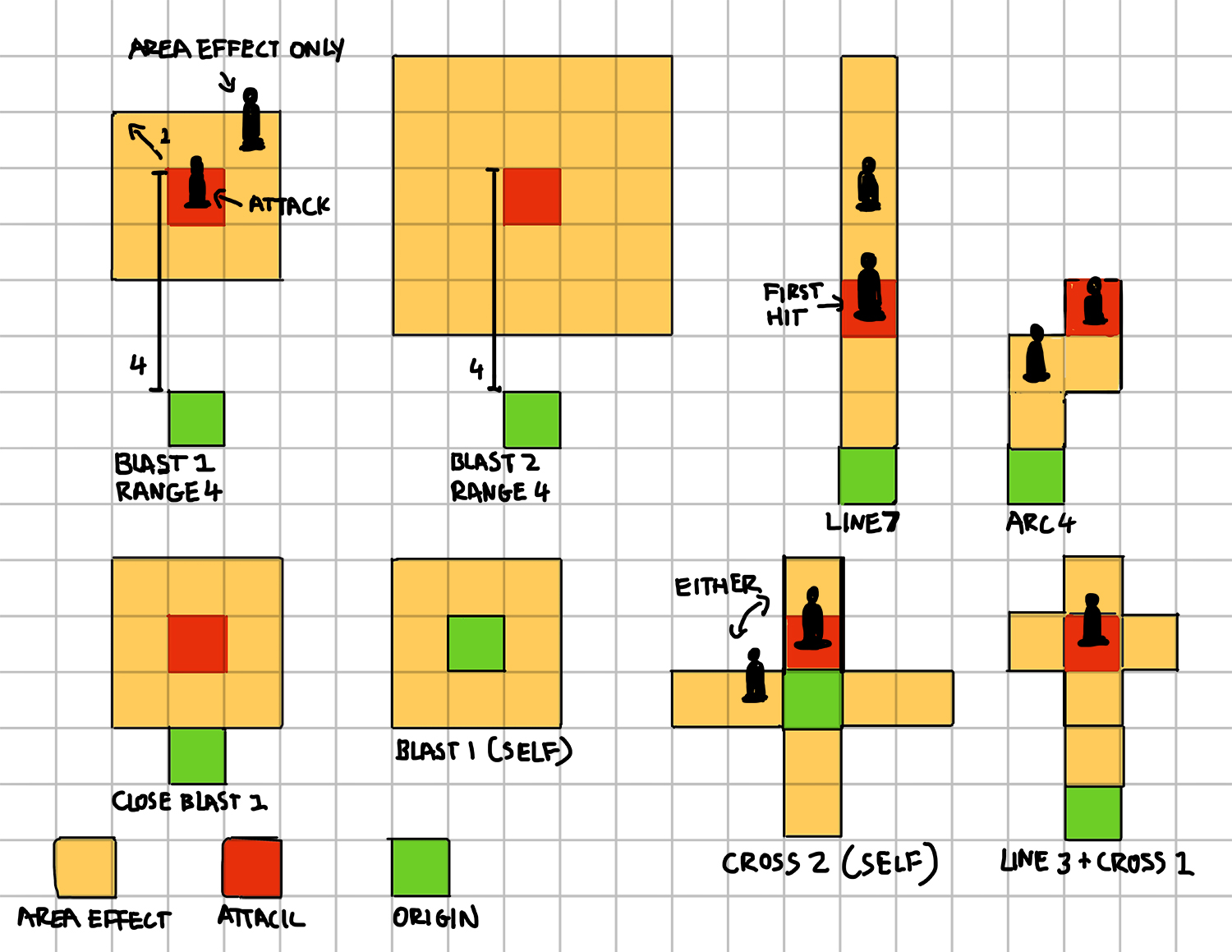
Area effect abilities have a listed pattern (described and illustrated below) that specifies where its area and attack spaces are.
The origin space of an ability is any space of the ability user unless otherwise specified (or if specified as “(self)”.
AoE abilities with no listed range or a target of “(self)” don’t affect the caster. Abilities with a range can affect the caster.
AoE abilities cannot overlap their origin space unless that origin space is “(self)”.
Cover for AoE abilities is determined by the origin point (usually the user of the ability).
Combined AoE patterns (such as “Line 3 + Cross 2”) start the secondary AoE pattern from the first pattern’s attack space. The secondary pattern does not have an attack space of its own.
AoE patterns
AoE attack pattern diagrams
Line X: a line X spaces long, with at least one space adjacent to the origin space. Cannot be placed diagonally. Attack space is the first character other than the caster in the area.
Blast X: A central space with X spaces around it in every direction, plcaed in the range listed from the origin space. Attack space is the central space.
Close blast X: A blast that must be places so that at least one space of the total area is adjacent to the origin space.
Arc X: X contiguous spaces, with at least one directly adjacent to the origin space. If it has a listed range, can be placed in range. Spaces cannot be placed diagonally and cannot overlap, but otherwise can be placed in any pattern. Attack space is the final space.
Cross X: X spaces in every orthogonal direction, drawn from the origin space. Attack space is the first character (attacker’s choice if there’s a tie), or origin space if the attack has a listed range.
The battlefield
The battlefield is abstracted as a grid of notionally 5 ft. by 5 ft. squares. Distances are measured in squares from the edge of the origin space or character.
Each space has a type:
Ground: No special effects.
Difficult terrain: Costs +1 space of movement to move out of.
Dangerous: Take piercing damage equal to the chapter number when you move into the space.
Impassable: Blocks line of sight and all movement except phasing.
Terrain: Categorized by height from 1-3. Blocks movement. Provides cover if you’re the same height, blocks line of sight if you’re smaller. Characters can move up and stand on top of it. Costs +1 movement per difference in height to move up onto, but no extra to move down from.
Destructible terrain: Some terrain can be destroyed. It has 10 HP per height and attacks automatically hit.
Terrain advantage:
Cover: grants resistance to damage from ranged attacks.
Height advantage: +1 boon on attacks against a target on a lower elevation than you. Increase range by +1 space for each level of height.
Height disadvantage: +1 curse on attacks against a target on a higher elevation.
Other bits:
Falling: If a character is shoved or moves so that they would move down more than 1 space of terrain, they take physical damage for every space they fall (2 or 3 damage). Falling happens immediately.
Edges: Some areas of maps can be edges. Characters that end any turn off an edge are removed from play, unless they pass a save to move to the closest non-edge space instead. Player characters can return to play at the start of their next turn, as close to where they moved off an edge as possible. Foes (other than mobs) or NPCs can re-enter the battlefield at the start of their next turn at the GM’s discretion. Flying characters can cross but not end their turn in an edge area.
Statuses and other effects
Statuses are negative effects applied by some abilities or traits.
At the end of your turn, you can make a save roll (separately) for each status currently affecting you. On a successful save, the status ends.
Ongoing statuses, often caused by your own abilities, cannot be removed.
Blights are a more durable form of elemental debuff. Characters take armor-ignoring damage at the start of their turn equal to the number of blights (four are possible) affecting them. This damage cannot reduce a character past 1 HP.
Blights are only cleared at the end of combat or when removed by an ability.
Many abilities have enhanced effects against targets affected by certain blights.
Characters below 50% HP are considered bloodied. This has no direct effects, but many abilities and traits have different effects depending on whether a character is bloodied.
Characters who have been defeated are incapacitated. Incapacitated character don’t cause engagement, are immune to damage, and cannot act until combat ends or an ally uses the rescue action on them.
Victory and defeat
When a character is reduce to 0 HP, they are defeated.
Defeated player characters clear all effects on them, gain a wound, and become incapacitated until somebody rescues them.
If a player character with 3 wounds would become defeated and gain a wound, they die instead.
Defeated foes are incapacitated, don’t cause engagement or obstruction, and are immune to damage and effects.
Depending on the game’s tone and the situation, defeated foes may be killed or merely unable to keep fighting. Battles usually aren’t to the death unless monsters are involved.
When any character would be damaged by an action or ability, they can instead surrender.
They become immune to all damage and effects from that action or ability.
They immediately become defeated for the rest of the battle.
They cannot be rescued, but do not gain a wound.
Combat normally ends when every character of one side is defeated, dead, or has fled the battlefield. Sometimes there are alternate victory/defeat conditions.
If all player characters are defeated or dead, they are totally defeated as a party and at the mercy of their foes. It’s up to the GM (and the tone of the game) what the foes do with them.